Odd-meter rhythms: playing 5/8, 7/8 and 9/8 on guitar
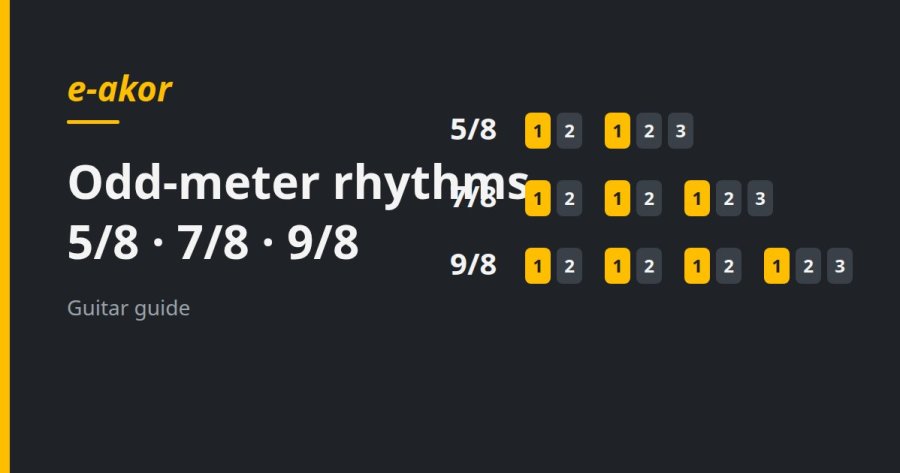
Most Western pop is in 4/4 or 3/4, where the bar is split into equal beats. In Turkish folk music, Turkish classical music and Balkan tunes, however, you very often meet aksak ("limping") rhythms. They are called that because the bar is divided into unequal groups: groups of two and three sit side by side, and the rhythm feels as if it limps.
The secret to playing aksak rhythms rests on a single rule: the first beat of every group is accented and played as a downstroke.
How to count
Count the eighth notes in groups. A group of two is counted "1-2", a group of three "1-2-3", and the "1" of each group is played a little stronger.
5/8
- Grouping: usually 2 + 3 (3 + 2 in some tunes)
- Count: 1-2 1-2-3
- Guitar: Down-up | Down-up-down
In Turkish classical music this rhythm's usul (rhythmic cycle) is called Türk aksağı. Play it slowly at first, counting all five beats; speed up once the accents feel settled.
7/8
- Grouping: 2 + 2 + 3 or 3 + 2 + 2
- Count: 1-2 1-2 1-2-3 (or 1-2-3 1-2 1-2)
- Guitar: Down-up | Down-up | Down-up-down
In Turkish classical music the 3 + 2 + 2 grouping is called Devr-i hindî. Most horon dances from the Black Sea region are also in a seven-beat rhythm grouped 2 + 2 + 3; because they are played much faster they are usually written in 7/16.
9/8
- Grouping: most commonly 2 + 2 + 2 + 3
- Count: 1-2 1-2 1-2 1-2-3
- Guitar: Down-up | Down-up | Down-up | Down-up-down
Roman (Romani) dance tunes and karşılama dances use this rhythm. Zeybek dances are also built on a nine-beat rhythm but are played at a very slow tempo (usually written in 9/4); Harmandalı is the best-known example.
How to practise
- Clap first: Put the guitar down and get the rhythm into your body by counting the groups and clapping the accents.
- Play a single chord: Strum one chord such as Am for a minute, accenting the downstrokes.
- Use a metronome: Set it to the eighth note and start slowly (for example 120 eighth notes per minute).
- Change chords at the start of a group: Chords usually change at the beginning of a group. Land the change on the accented beat and the rhythm won't break.
- Listen to the recording: The grouping on paper is a starting point; the real feel comes from the recording. Listen to where the accents fall and adjust your count.
Related pages: Turkish songs · Easy Turkish songs · Chord Chart
Comments
Leave a comment
You need to log in to leave a comment.
Log in