How to play barre chords: getting F and Bm to ring clean
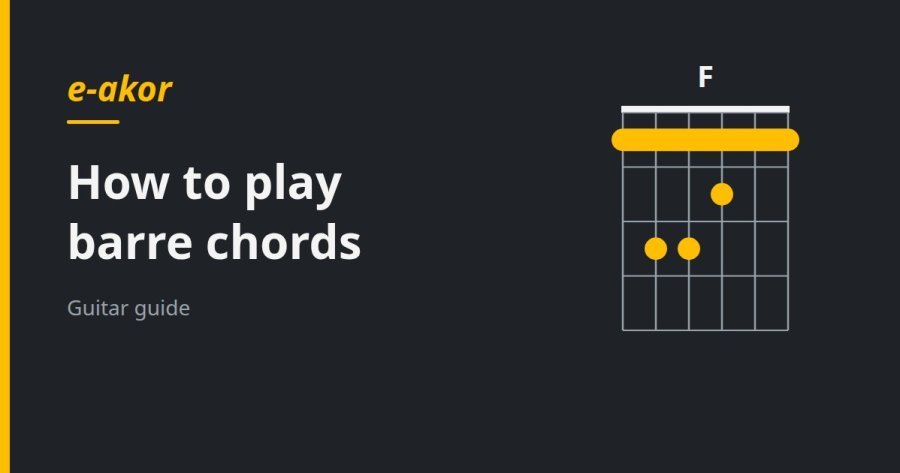
Barre chords are the first big hurdle for almost every new guitarist. If you close the page when you see F, Bm, F#m or C#m in a song, you are not alone. The good news: a barre is not about strength, it is about placement. Once you find the right position you get a clean sound with much less force.
What is a barre chord?
In a barre chord your index finger presses several strings at the same fret on its own; it works like a capo. Your other fingers build a familiar open chord shape on top of it. So barre chords are really open chords you already know, moved up the neck:
| Chord | Fingering | Based on the shape of |
|---|---|---|
| F | 1 3 3 2 1 1 | E (E major), 1st fret |
| F#m | 2 4 4 2 2 2 | Em, 2nd fret |
| Gm | 3 5 5 3 3 3 | Em, 3rd fret |
| Bm | x 2 4 4 3 2 | Am, 2nd fret |
| B | x 2 4 4 4 2 | A, 2nd fret |
| Cm | x 3 5 5 4 3 | Am, 3rd fret |
| C#m | x 4 6 6 5 4 | Am, 4th fret |
Once you learn a shape you can move it to any fret: slide the Em shape to the 5th fret and you get Am; slide it to the 7th fret and you get Bm.
5 adjustments for a clean sound
- Place the finger right behind the fret wire. Pressing close to the metal fret, not in the middle of the fret space, noticeably reduces the force you need.
- Roll the index finger slightly onto its side. Use the bony outer edge instead of the soft inside; strings that fall into the creases of your finger will stop going dead.
- Keep your thumb behind the neck, in the middle. Instead of squeezing the neck with your palm, let the thumb and index finger work against each other like a clothes peg.
- Take the power from your arm. Pulling your elbow slightly toward your body transfers the weight of your arm to the finger, so your hand tires later.
- Check string by string. Fret the chord and pick the strings one at a time. Fix only the finger at the spot where a string sounds muted.
Start with easier versions
Before moving to a full barre you can use smaller versions of the same chord. The song still flows, and your hand gets used to it:
- Small F: x x 3 2 1 1 (you barre only the two thinnest strings)
- Fmaj7: x x 3 2 1 0 (no barre at all; works in place of F in many pop songs)
- Small Bm: x x 4 4 3 2
- Bm7: x 2 0 2 0 2 (a softer colour of Bm; fits ballads well)
A 5-minute daily barre routine
- Minute 1: Press all six strings at the 5th fret with just your index finger and pick them one by one. If the sound is clean, release, rest and repeat.
- Minutes 2–3: Small F → full F. Fret the small F first, then add the thick strings.
- Minutes 4–5: Change from an open chord you know to a barre chord: C → F, G → Bm, Am → F. Clean, not fast.
After a few weeks of regular practice your fingertips harden and barre chords stop being "the hard chords".
Skipping the barre altogether: the capo
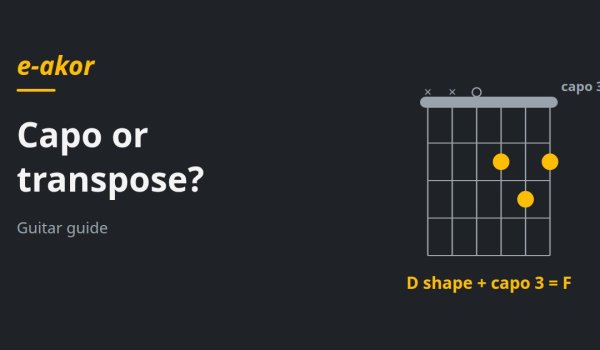
If a song has too many barre chords you can play the same key with open shapes using a capo. Song pages on E-Akor include a capo suggestion worked out from the chords: it shows which fret to put the capo on and which easy shapes to play. For the details see the Capo or transpose? guide.
Related pages: Chord Chart · Chord Transposer · Easy guitar songs
Comments
Leave a comment
You need to log in to leave a comment.
Log in